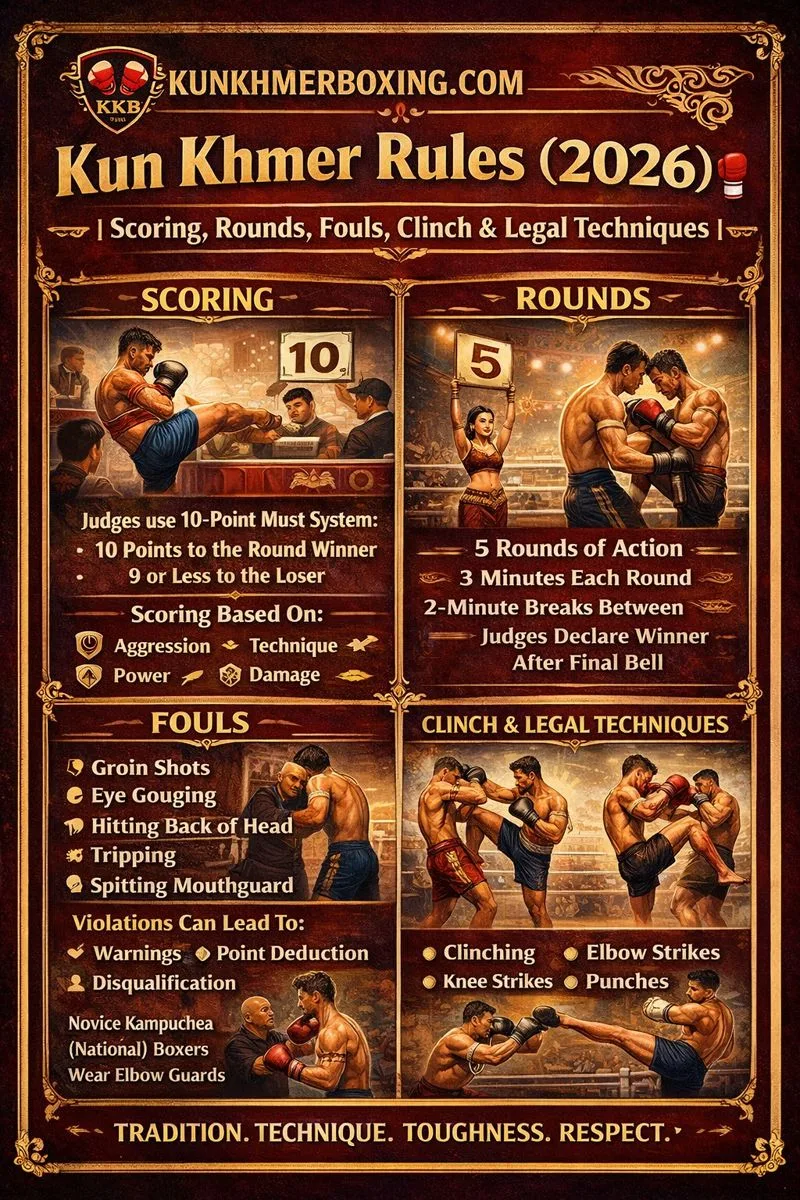
Want to understand Kun Khmer fast? This page breaks down the core rules in a simple way: rounds, scoring, legal strikes, clinch basics, fouls, and what judges usually look for. Perfect if you’re watching fight night 🎥 or training in the gym 🏋️.
✅ Helpful pages: Kun Khmer Glossary • Weight Classes • Schedule • Training • KKB Weekly Plan
1. Table of Contents 📌
- 2. What is Kun Khmer?
- 3. Fight format: rounds & time
- 4. Legal techniques (what you can do)
- 5. Clinch rules (simple)
- 6. Scoring & judging (how fights are won)
- 7. Fouls & illegal moves
- 8. Referee commands (fight-night guide)
- 9. How to read a fight like a judge
- 10. FAQ
2. What is Kun Khmer? 🇰🇭
Kun Khmer is Cambodia’s striking combat sport. It’s known for strong fundamentals (stance + balance), powerful kicks, sharp elbows, tough clinch exchanges, and forward pressure. If you already watch Muay Thai, you’ll feel the similarities — but the pacing, rhythm, and scoring details can look different depending on promotion and judging style.
3. Fight Format: Rounds & Time ⏱️
Most Kun Khmer matches follow a familiar ring sport structure: rounds, a referee, judges, gloves, mouthguard, and standard safety checks.
Fight format (quick table) 📋
| Item | Typical Setup | What it means for fighters 👀 |
|---|---|---|
| Rounds | Usually 5 rounds (varies by event) | Start smart, build pressure, finish strong 🔥 |
| Round time | Often 3 minutes | Work in bursts, then recover fast ⚡ |
| Rest | Typically 1 minute | Breathe, reset guard, listen to coach 🧠 |
| Win conditions | Points, KO, TKO, stoppage | Clean impact + control matters ✅ |
| Referee | Controls clinch, safety, fouls | Obey commands immediately 🛡️ |
Pro tip: If you’re a beginner, train your conditioning smart. A good reference is our interval day: Day 5 Conditioning Intervals 🔥
4. Legal Techniques ✅ (What You Can Do)
Kun Khmer is striking-first. The core is punches, kicks, knees, and elbows — plus clinch control.
Legal techniques (table) 🥊
| Technique | Allowed? | Common use | Coaching tip 💡 |
|---|---|---|---|
| Punches (jab, cross, hook, uppercut) | ✅ Yes | Enter, score, set up kicks | Hit and return to guard fast 🧤 |
| Kicks (body, low kick, step-kick timing) | ✅ Yes | Damage + distance control | Balance + recovery = real power ⚡ |
| Knees | ✅ Yes | Clinch scoring, body damage | Lift knee tight, don’t swing wide 🎯 |
| Elbows | ✅ Yes | Close range, cuts, big moments | Set it up with guard + angle 🪓 |
| Clinch control | ✅ Yes | Stop attacks, knee, turn, break rhythm | Control head/arms, stay calm 😤 |
Want drills that match these rules? Start here:
- 🦶 Teep basics (range control): Teep Technique Basics
- 🛡️ Defense basics: Punch Defense (Block/Slip/Counter)
- 🦵 Kick control: Day 3 Kick Control
5. Clinch Rules (Simple) 🤝
The clinch is where fights can swing fast. In Kun Khmer, clinch work is about control + knees + turns. Referees usually break clinch when there’s no action, or if it becomes unsafe.
Clinch: do & don’t (table) 🧷
| Clinch action | Usually OK? | Why it matters | Best practice ✅ |
|---|---|---|---|
| Control head/arms and knee | ✅ Yes | Scores + breaks opponent posture | Knee straight, posture tall 🧱 |
| Turn/pivot to off-balance | ✅ Often | Shows dominance & control | Small pivot, keep base under you 🔁 |
| Hold without attacking | ⚠️ Risk | Ref breaks if no action | Work: knee, turn, or exit 🧠 |
| Dangerous throws / spikes | ❌ No | Safety issue | Keep it controlled, fight clean 🛡️ |
| After break: strike instantly | ⚠️ Depends | Can be ruled unsafe | Wait for the “fight” signal 🧑⚖️ |
For defense + reset concepts that help in clinch exits, check:
- 🛡️ Defense + counters day: Day 4 Defense + Counters
- 🧭 Pivot drill guide: Counter + Pivot Drill Tables
6. Scoring & Judging 🧑⚖️ (How Fights Are Won)
Judges usually reward what looks like clean impact, balance, control, and effective aggression. “Busy” shots that don’t land cleanly often score less than a few sharp, clear strikes.
What scores best (table) ✅
| Scoring factor | What judges like | Easy example 🎯 | Quick tip |
|---|---|---|---|
| Clean impact | Clear strike that lands solid | Body kick that moves opponent | Hit clean, recover stance ⚡ |
| Balance | Stay stable after attacking | Kick → return to guard | Don’t fall, don’t stumble 👣 |
| Ring control | Control space and pace | Teep keeps center | Own the center line 🧭 |
| Defense into counter | Make them miss then punish | Check kick → counter kick | Defend first, then score 🛡️ |
| Clinch dominance | Control + knees + turns | Inside knee while controlling head | Posture tall, knees tight 🤝 |
If you want the “fight IQ” approach (distance + control), start with:
- 📏 Out-fighter style guide: Out-Fighter Kick Control
- 🥊 Jab-only distance drill: Jab-Only Shadow Boxing
7. Fouls & Illegal Moves ❌
Rules can vary slightly by event, but these are common “don’t do it” actions that lead to warnings, point deductions, or disqualification.
Common fouls (table) 🚫
| Illegal / foul | Why it’s a problem | Typical referee action | Safer alternative ✅ |
|---|---|---|---|
| Striking the back of the head | High injury risk | Warning / point deduction | Angle to front/side targets 🎯 |
| Eye gouging / biting | Dangerous + unsportsmanlike | DQ possible | Use legal clinch control 🤝 |
| Groin strikes | Illegal target | Time + warning | Aim clean to body/legs ✅ |
| Headbutts | High cut risk | Warning / deduction | Use elbows the legal way 🪓 |
| Attacking after referee break | Unsafe moment | Warning | Reset first, then fight 🛡️ |
8. Referee Commands (Fight-Night Guide) 🗣️
Even as a fan, knowing referee cues makes watching cleaner.
Common referee actions (table) 🧑⚖️
| Ref action | What it means | What fighters should do |
|---|---|---|
| Break! | Stop clinch, separate | Let go, step back, hands up 👐 |
| Fight! | Resume action | Re-enter safely, score clean ✅ |
| Stop! | Instant halt | Freeze, await instruction 🧊 |
| Count | Knockdown evaluation | Recover, show control, stand stable 😤 |
| Warning | Rule violation | Adjust immediately, stay clean 🛡️ |
9. How to Read a Fight Like a Judge 👀
Use this simple checklist when you watch:
- ✅ Who lands the cleaner shots?
- ✅ Who keeps balance after attacking?
- ✅ Who controls the center and the rhythm?
- ✅ Who wins defense → counter exchanges?
- ✅ Who dominates clinch with knees and posture?
To follow events and replays, go here: Video Replay Hub 🎥
10. FAQ ❓ Kun Khmer Rules
Is clinch allowed in Kun Khmer?
Yes ✅ Clinch is a big part of Kun Khmer. It’s used for control, knees, and turning the opponent. Referees usually break the clinch if there is no action.
Are elbows legal in Kun Khmer?
Yes ✅ Elbows are legal and often change fights quickly. The key is to land them clean and stay balanced after the strike.
What scores more: punches or kicks?
It depends on clean impact and effect. A sharp body kick that clearly lands often looks stronger than light punches. But clean punches that snap the head back also score well 🥊
Do knockdowns guarantee winning the round?
Usually a knockdown is a big advantage ✅ but judging can still consider what happened before and after. Strong control + clean scoring after a knockdown matters.
What are the most common fouls?
Back of head strikes, groin strikes, headbutts, and attacking after the referee breaks the clinch are common fouls 🚫
Where can I learn the technique safely?
Start with fundamentals and defense first 🛡️: Beginners Guide, then follow the KKB Weekly Training Schedule.
11. Next Steps 🚀
If you want to go deeper, here’s the perfect path:
- 📚 Learn the terms: Kun Khmer Glossary
- ⚖️ Understand divisions: Kun Khmer Weight Classes
- 📅 Follow events: Schedule
- 🏋️ Train smart: Training Hub