
KKB Step-In Body Kick (Rear Leg) 🦵 Small Step, Big Damage (No Telegraph) KKB Step-In Body Kick (Rear Leg) 🦵 Small Step, Big Damage (No Telegraph)
KKB Step-In Body Kick (Rear Leg) 🦵 Small Step, Big Damage (No Telegraph) គឺជាកំណត់ត្រា គុនខ្មែរ ក្នុងមូលដ្ឋានទិន្នន័យ KKB។
English
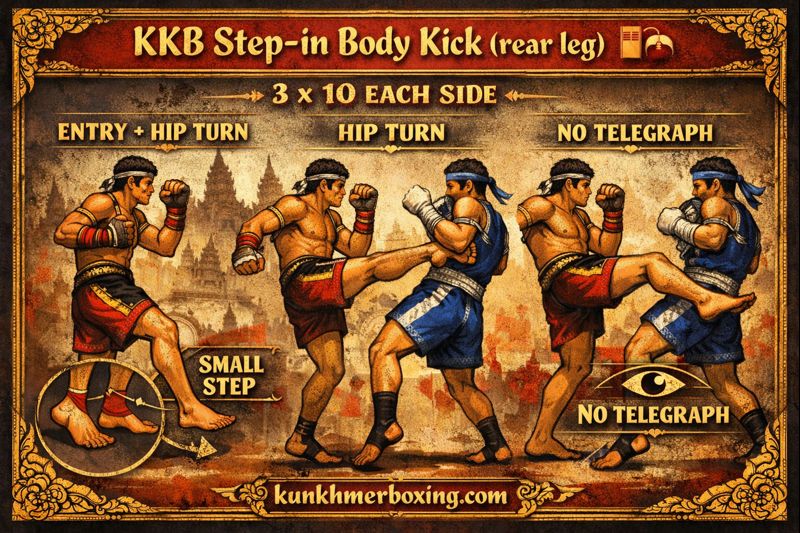
The KKB Step-In Body Kick (rear leg) is one of the cleanest ways to land a hard body kick without giving your opponent time to read it. 👀 The secret is simple: a small step + fast hip turn — not a big run-up, not a loud chamber, not a “warning” move.
On this page you’ll learn the exact mechanics, a simple drill plan (3 x 10 each side), entries, combos, common mistakes, and progressions so you can use it in sparring and fights.

1. What Is the KKB Step-In Body Kick?
This kick is a rear-leg round kick to the ribs/body that starts with a small forward step (or “step-in”) to:
- ✅ close distance quickly
- ✅ hide the kick (less telegraph)
- ✅ load your hips for power
- ✅ change angle slightly (better line to the ribs)
It’s perfect for KKB style because it blends well with pressure footwork and fast entries.
2. Why It Works (No Telegraph 👀)
Most body kicks fail for one reason: the opponent sees it coming. The step-in version fixes that by making your kick look like a normal entry step.
- 👀 Small step = the opponent reads “punch” not “kick”
- ⚡ Fast hip turn = power + speed at the same time
- 🎯 Better range = you don’t need to lean or reach
- 🛡️ Cleaner recovery = easier to check/step out after
3. Step-by-Step Technique (Rear Leg)
Here’s the simplest technical checklist. Practice it slow first, then speed up.
- Start in stance: hands up, chin down, eyes forward 🥊
- Small step-in: lead foot steps forward just a little (no big hop) 🦶
- Turn the base: pivot on the lead foot as your hips rotate
- Whip the rear leg: shin to ribs (or lower ribs) 🦵
- Arm swing for balance: opposite arm drops slightly (controlled, not wild)
- Return fast: recoil the leg + reset stance
- Exit: step out or angle out (don’t admire the kick) ↩️
4. Key Details: Entry + Hip Turn
✅ The Small Step
- Keep it short (usually 10–25 cm)
- Step quiet (no stomp)
- Body stays relaxed (no stiff “loading” posture)
✅ The Hip Turn
- Turn your hip like you’re closing a heavy door 🚪
- Pivot the lead foot so the knee is safe
- Strike with the shin, not the foot
Power tip: the kick feels effortless when your hip does the work. If your leg feels heavy, your hip is late.
5. Drill Plan: 3 x 10 Each Side (KKB Standard)
This is your core practice set:
- Set 1: 10 step-in body kicks (right) + 10 (left) — slow & perfect ✅
- Set 2: 10 + 10 — medium speed, focus on no telegraph 👀
- Set 3: 10 + 10 — fast snap + fast recovery ⚡
Rest: 30–60 seconds between sets.
Coaching cue: every rep ends with a clean reset stance and guard.
6. Bag / Pads / Partner Progression
Shadow Boxing (No Equipment)
- Step-in → kick → recoil → exit angle
- Do 2 minutes each side
Heavy Bag (Power + Accuracy)
- Hit the ribs line (mid bag)
- Focus on shin contact + balance
- Don’t push — whip
Pads (Timing + Entry)
- Pad holder gives a visual cue (hands up like a guard)
- Step-in should look like a jab entry
Partner (Control)
- Light touch to body protector
- Train entry + exit, not power
7. Best Setups & Entries
If you throw it naked, people read it. Use a setup:
- 🎭 Feint jab → step-in body kick
- 🦶 Teep touch → step-in body kick (rear)
- 🥊 Jab pressure → step-in kick when they shell up
- ↩️ Exit angle → re-enter with step-in kick
Best moment: when the opponent’s weight is on the back leg or when their guard is tight and high.
8. Combos to Land the Kick 🧩
- Combo 1: Jab → Cross (touch) → Step-in Body Kick 🦵
- Combo 2: Jab (feint) → Step-in Body Kick → Exit angle ↩️
- Combo 3: Teep (light) → Step-in Body Kick → Jab to reset 🦶🥊
- Combo 4: Jab → Step-in Body Kick → Low kick (optional) 🔥
Coaching rule: If your punches are heavy, your kick becomes predictable. Keep punches as “cover”, then explode with the kick.
9. Common Mistakes (Fix Fast) ❌✅
- ❌ Big step / hop → ✅ small step only (quiet feet)
- ❌ Leaning back → ✅ keep chest stacked over hips
- ❌ Dropping hands too early → ✅ guard stays until hip turns
- ❌ No pivot → ✅ pivot lead foot to protect knee
- ❌ Pushing the kick → ✅ whip the shin, snap back
- ❌ Slow recovery → ✅ recoil fast + exit immediately
10. How to Use It in Sparring 🛡️
In sparring, make it clean and safe but still realistic:
- ✅ Touch to body, full technique
- ✅ Focus on entry + timing
- ✅ Always recover and exit (avoid counters)
Smart strategy: land it early to slow their breathing, then later mix in teeps and low kicks to open the body again.
11. Keep Building Your KKB System 📚
Use these pages to connect your technique into a full game:
- 🔥 Technique hub: Kun Khmer Techniques
- 🦶 Teep foundation: KKB Teep Technique Basics
- 📏 Range & control: Day 2 – Teep & Range Control
- 🦵 Kick control day: Day 3 – Kick Control (Long Weapons)
- ↩️ Footwork timing: Step-In / Step-Out Footwork Drill
- 🧠 Angles: Angle Exit Drill
- 🥊 Sparring guide: Sparring Training
- 🛡️ Stay safe: Injury Prevention
12. FAQ ❓
Why do a step-in before the rear body kick?
The step-in hides the kick, closes distance, and loads your hip turn for more power. It also makes your entry look like punches, which reduces telegraphing.
How far should the step-in be?
Small. Usually 10–25 cm. If it becomes a hop or a big stride, your opponent reads it early and your balance gets worse.
Where should I aim on the body?
Aim around the ribs (mid-body). On the bag, target the middle line. In sparring, touch light with control.
Is this kick good for beginners?
Yes, because it teaches correct range and hip turn. Beginners should start slow, focus on pivot and balance, then speed up.
What are the most common counters?
The most common are a check, a catch (if slow), or a straight punch during your entry. That’s why recovery + exit angle matters.
ភាសាខ្មែរ
KKB Step-In Body Kick (Rear Leg) 🦵 Small Step, Big Damage (No Telegraph) គឺជាកំណត់ត្រា គុនខ្មែរ ក្នុងមូលដ្ឋានទិន្នន័យ KKB។
Database context / បរិបទទិន្នន័យ
KKB Step-In Body Kick (Rear Leg) 🦵 Small Step, Big Damage (No Telegraph) is maintained as a Page record in the KKB master database.
ទិន្នន័យនេះត្រូវបានរក្សាទុក និងធ្វើបច្ចុប្បន្នភាពក្នុងមូលដ្ឋានទិន្នន័យមេ KKB។