
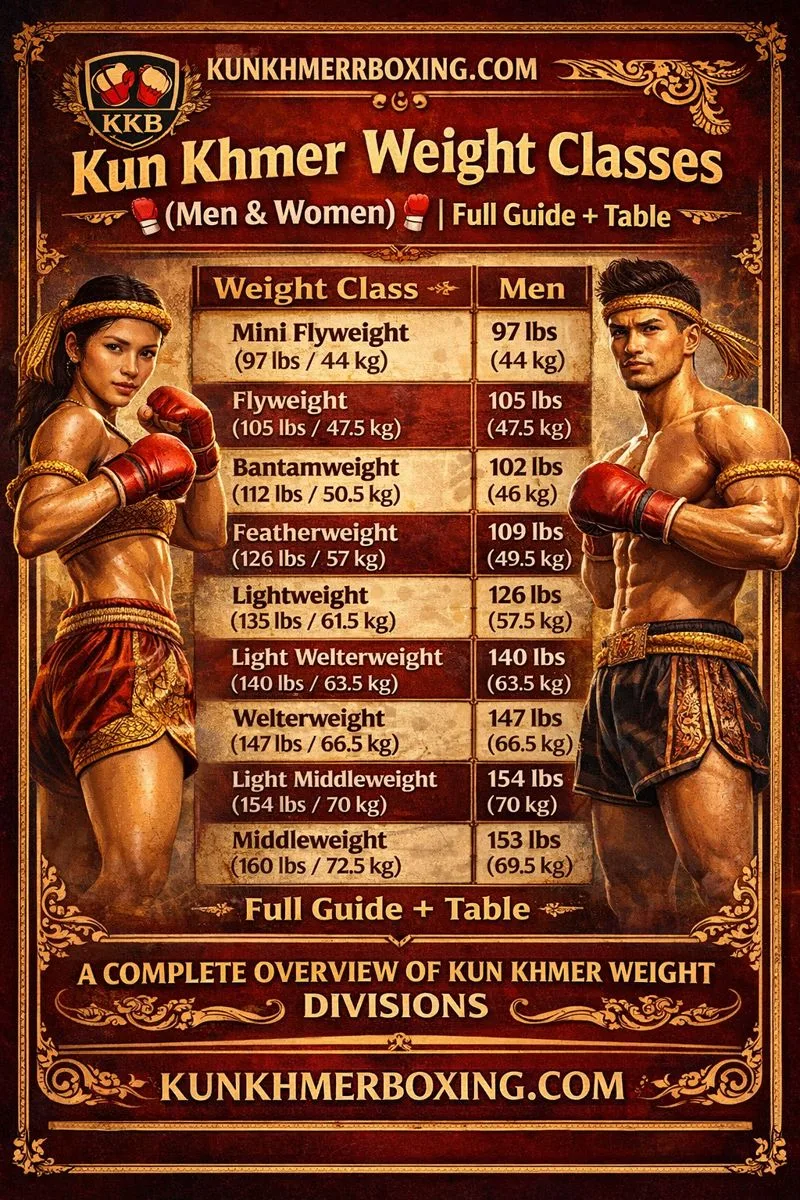
Kun Khmer weight classes help keep fights fair, safe, and competitive ✅. If you’re a beginner, a fan, or a fighter preparing for a bout, this page makes it simple: a clean weight class table, how to choose your division, and smart tips to avoid dangerous cuts. 💧
Quick links: Rankings & Records • Fighters • Kun Khmer Rules • Training • Fight Schedule
📌 Table of Contents
- What are weight classes in Kun Khmer?
- Kun Khmer weight classes table (kg + lb)
- How to choose your weight class 🎯
- Weigh-in basics + safe weight cut tips 💧
- Training focus by weight class 🧠
- Related pages (rankings, fighters, rules) 🔗
- FAQ ❓
1. What are weight classes in Kun Khmer? ⚖️
Weight classes divide fighters into groups based on body weight. That way, a smaller fighter isn’t forced to fight someone much heavier. In striking sports like Kun Khmer, even a few kilos can change power, clinch strength, and durability. 🥊
- ✅ Fair matchups
- ✅ Better safety
- ✅ Clear rankings + titles
- ✅ Easier matchmaking for promoters
Good to know: exact divisions can vary slightly by promotion/organization, but most events follow common “boxing-style” divisions in kilograms. This page gives the most user-friendly standard list used across many shows.
2. Kun Khmer Weight Classes Table (kg + lb) 📊
Here’s an easy table you can use right away. If your promotion lists “-60 kg”, that means up to 60 kg. ✅
| Division | Limit (kg) | Limit (lb) | Typical Style | Fan Tip 👀 |
|---|---|---|---|---|
| Mini Flyweight | 47.6 kg | 105 lb | Fast entries + high pace | Footwork battles 🔥 |
| Flyweight | 50.8 kg | 112 lb | Speed + timing | Sharp counters ⚡ |
| Bantamweight | 53.5 kg | 118 lb | Speed + power balance | Clean combos 🎯 |
| Featherweight | 57.2 kg | 126 lb | Volume striking | Kick-punch flow 🦵 |
| Lightweight | 61.2 kg | 135 lb | All-around | Best “mixed skills” division 🧠 |
| Super Lightweight | 63.5 kg | 140 lb | Pressure + counters | Leg kicks matter ✂️ |
| Welterweight | 66.7 kg | 147 lb | Power + clinch strength | Big momentum shifts 💥 |
| Super Welterweight | 69.9 kg | 154 lb | Pressure fighting | Body shots pay 🥊 |
| Middleweight | 72.6 kg | 160 lb | Strength + control | Clinching becomes key 🛡️ |
| Super Middleweight | 76.2 kg | 168 lb | Heavy kicks | One kick changes rounds 🦵 |
| Light Heavyweight | 79.4 kg | 175 lb | Power first | Don’t blink 😅 |
| Cruiserweight | 90.7 kg | 200 lb | Strong clinch + power | Big frames collide 🧱 |
| Heavyweight | 90.7+ kg | 200+ lb | Knockout threat | Power at any moment 💣 |
Women’s divisions: many shows use the same idea (kg limits) but fewer categories depending on the event. If you follow women’s Kun Khmer, check: Women Training ✅
3. How to choose your weight class 🎯
If you’re training and want to compete later, the best weight class is usually the one where you feel:
- ✅ strong in sparring
- ✅ cardio stays good for all rounds
- ✅ you can eat normally (not starving)
- ✅ you recover fast after hard sessions
⭐ Simple rule: pick the class closest to your normal walking weight. If you must do a big cut, you’ll usually lose speed, chin, and focus — not worth it. 🧠
4. Weigh-in basics + safe weight cut tips 💧
Most fighters reduce weight by adjusting food/water before weigh-in. But cutting too hard is risky. Keep it smart. ✅
✅ Safe cut checklist (beginner-friendly)
- 🥤 Hydrate daily (don’t “panic cut” the last day)
- 🍚 Eat clean carbs + lean protein (no junk bloat)
- 🧂 Reduce salty food before weigh-in (less water retention)
- 🛌 Sleep more (bad sleep = bad weigh-in + bad fight)
- 🚫 Avoid extreme dehydration methods
If your goal is long-term progress (and fewer injuries), build a strong base here: Nutrition & Recovery and Injury Prevention. 💪
5. Training focus by weight class 🧠
Each division tends to reward different strengths. Use this as a smart training guide (not a strict rule). 👇
| Weight Zone | Best Focus | Top Skills | Training Link 🔗 |
|---|---|---|---|
| 47–57 kg (lighter) | Speed + angles | Footwork, jab, counters | Footwork Drill |
| 58–67 kg (mid) | Balance + volume | Kicks, checks, combos | KKB Weekly Plan |
| 68–76 kg (upper mid) | Pressure + defense | Clinching, pivots, counters | Day 4 Defense |
| 77 kg+ (heavy) | Power + gas tank | Control, pacing, recovery | Workouts |
Want a simple daily structure that fits most weight classes? Start here: Warm-Up & Stretching ✅
6. Related pages (rankings, fighters, rules) 🔗
- 🏆 Rankings & Records — see who’s climbing
- 👊 Fighters — profiles + highlights
- 📜 Kun Khmer Rules — scoring, rounds, basics
- 📅 Schedule — upcoming events + results
- 🎥 Training Videos — learn visually
7. FAQ ❓
What’s the most common Kun Khmer weight class?
Many events feature a lot of action around the mid divisions (roughly lightweight to welterweight). These classes often have the best mix of speed, power, and high pace. ⚡
Are Kun Khmer weight classes exactly the same everywhere?
Not always. Some promotions adjust divisions slightly or use catchweights for special matches. Always check the official fight card, but this guide gives the standard structure used widely. ✅
How do I choose my weight class as a beginner?
Start close to your normal daily weight and focus on improving skills first. A big cut can reduce your cardio, chin, and concentration. Train smart before you “cut big.” 🧠
Is a fast weight cut dangerous?
Yes, extreme dehydration and rushed cuts increase risk and often make performance worse. If you want to improve safely, build a strong base with: Nutrition & Recovery and Injury Prevention. 💧
Where can I see real fighters by division?
Use these two pages together: Fighters (profiles) + Rankings (lists). That combo is perfect for fans and matchmakers. 🥊
Ready to go deeper? Train with the weekly structure here 👉 KKB Weekly Training Schedule 📆