
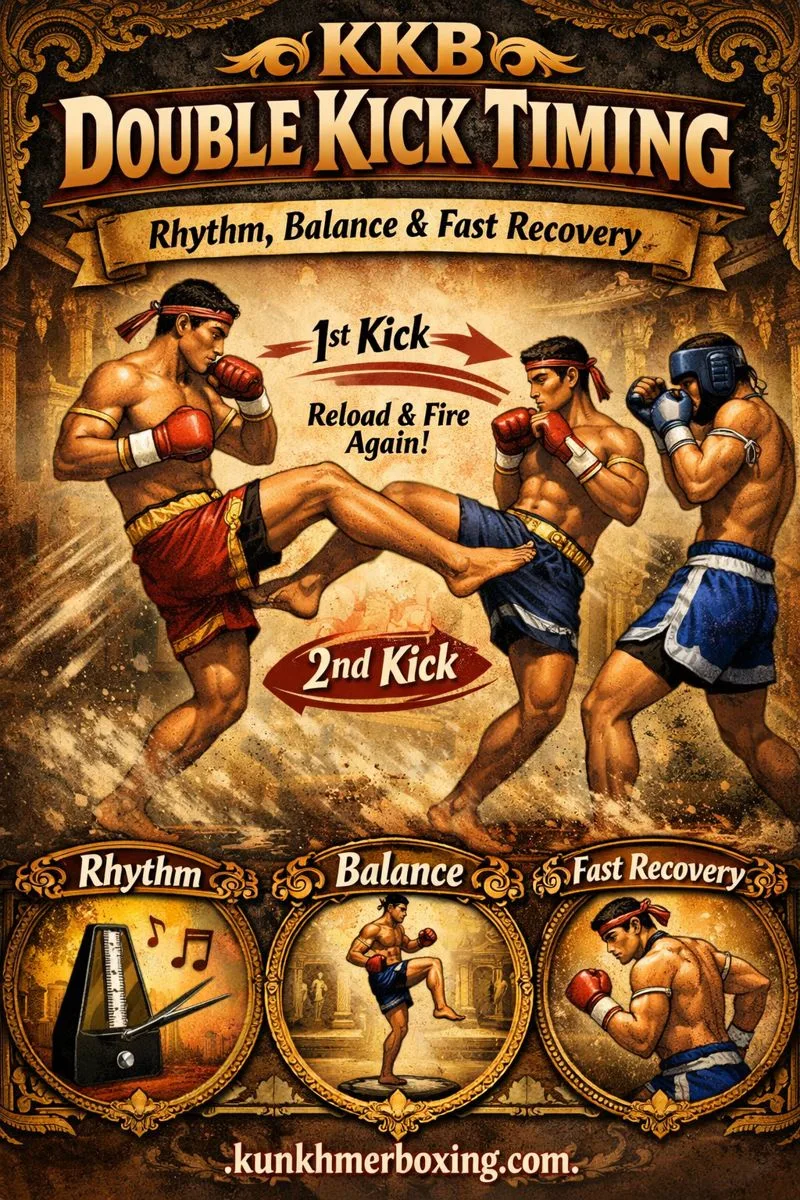
KKB Double Kick Timing (same leg) is a simple drill that builds elite kick control: you throw two kicks with the same leg using rhythm + balance — and the key rule is this:
✅ Second kick is quicker… not stronger. 🔁
This page gives you the full KKB method: how to do it, why it works, a 3×6 plan, variations, partner options, and the mistakes that kill timing.
📌 Table of Contents
- 1. What Is KKB Double Kick Timing (Same Leg)?
- 2. Why This Drill Works (Rhythm + Balance)
- 3. Technique Setup (Stance, Step, Hip)
- 4. KKB Plan: 3×6 (How to Train It)
- 5. Best Variations (Low/Body/High + Same Leg)
- 6. Timing Cues (Coach Tips)
- 7. Common Mistakes (Fix Fast)
- 8. Progressions (Beginner → Fighter)
- 9. Related KKB Drills & Training Pages
- 10. FAQ
1. What Is KKB Double Kick Timing (Same Leg)?
It’s a timing drill where you throw:
- Kick #1: clean technique, normal power
- Kick #2 (same leg): faster re-load + fast snap
Instead of trying to smash harder, the second kick is about speed, rhythm, and control. That’s what makes it realistic for fights: the second kick lands because it’s unexpected and fast. ⚡
2. Why This Drill Works (Rhythm + Balance)
Most fighters can throw one strong kick. The difference is who can reload and fire again without losing stance. This drill builds:
- 🧠 Timing: you learn when to re-kick before the opponent resets
- 🦵 Balance: you recover to stance instead of falling forward
- 🔁 Rhythm changes: “tap… SNAP” instead of “BOOM… BOOM”
- 🛡️ Safer kicking: quicker recovery means less counter risk
- 🥊 Fight realism: second kick punishes checks, steps, or guard drops
My opinion: this drill is one of the fastest ways to make your kicks look “pro” without adding power training. The quality comes from timing. ✅
3. Technique Setup (Stance, Step, Hip)
Stance ✅
- Feet under you (don’t stand too wide)
- Hands high (don’t let arms fly open)
- Chin down, eyes forward
Kick #1 (the “clean” kick)
- Turn hip through
- Kick returns fast (don’t pose)
- Land stable: you should be able to punch immediately
Reload for Kick #2 (the secret)
- Bring the kicking leg back quickly
- Touch the floor lightly (or hover-touch)
- Re-fire with the same leg using speed
Key feeling: Kick #1 is “normal”, Kick #2 is “snap + return”. 🔁
4. KKB Plan: 3×6 (How to Train It)
This drill is written like KKB style: 3 sets × 6 reps (each rep = two kicks with the same leg).
What counts as 1 rep?
- Kick #1 (same leg)
- Reload
- Kick #2 (same leg, faster)
Training structure (recommended)
- Set 1: 6 reps light (technique + balance) 🧘♂️
- Set 2: 6 reps medium (rhythm + speed) ⚡
- Set 3: 6 reps sharp (fast second kick + fast guard return) 🛡️
Rest: 45–75 seconds between sets. If form breaks, rest longer. Quality beats fatigue.
5. Best Variations (Low/Body/High + Same Leg)
Use these variations to build real fight options. Keep the rule: second kick is quicker, not stronger.
- 🦵 Low → Low: chop twice same leg (good vs heavy stance)
- 🦵 Body → Body: two body kicks same side (guard breaks)
- ⬆️ Low → Body: first sets the reaction, second scores
- 🎯 Body → High (advanced): only if balance is solid
Tip: If you’re not stable, stay with low → body. It’s the best “high percentage” version for most fighters.
6. Timing Cues (Coach Tips)
- ⏱️ “Kick… touch… kick” (tiny floor touch between kicks)
- 🎵 Rhythm: “one… two!” (second is faster)
- 🛡️ Guard rule: hands return to face before you admire anything
- 🧲 Stay stacked: head over hips (don’t lean)
- 🔁 Exit: after 2nd kick, step out or reset stance
7. Common Mistakes (Fix Fast) ❌
- ❌ Trying to make kick #2 stronger → ✅ make it faster and cleaner
- ❌ Falling forward after kick #1 → ✅ return leg under you, don’t chase
- ❌ Big pause between kicks → ✅ “touch and go” reload
- ❌ Hands drop → ✅ elbows tight, eyes forward
- ❌ Over-rotating the hip → ✅ control the turn so you can reload
Easy self-check: if someone can push you after kick #1 and you stumble, your recovery is too slow.
8. Progressions (Beginner → Fighter)
Beginner ✅
- Do it in the air (no bag)
- Slow kick #1, quick kick #2
- Focus only on balance + stance reset
Intermediate ⚡
- On heavy bag: low → body same leg
- Add jab before the first kick
- Finish with guard up + angle step
Fighter Level 🔥
- Partner drill: partner checks or steps back, you re-kick instantly
- Second kick becomes the scoring kick
- Add follow-up: cross or teep exit after the 2nd kick
9. Related KKB Drills & Training Pages 🔗
Build a full kicking system with these pages:
- 🦵 Kick control base: Day 3: Kick Control (Long Weapons)
- 🎯 Step-in kick mechanics: Step-In Body Kick (Rear Leg)
- 🛡️ Recovery habit: Body Kick Return to Guard
- 🦵 Low kick accuracy: Low Kick Outer Thigh Line Drill
- ✅ Defense after kicks: Kick to Check Defense
- 📚 Technique hub: Kun Khmer Techniques
- 👊 Start strong: Beginner Training Guide
- 🏠 Train anywhere: Home Training
- 🔥 Main training section: Training
10. FAQ ❓
Why is the second kick quicker, not stronger?
Because the goal is timing. A faster second kick lands before the opponent resets their guard or stance. If you try to hit harder, you usually slow down and lose balance.
How often should I train the 3×6 double kick drill?
2–4 times per week is perfect. Keep it technical. If your hips or shin get sore, reduce power and focus on speed + recovery.
Should I do this on the bag or in the air?
Both. Start in the air to build balance, then use the bag to improve impact control and fast reload timing.
Which kick is best for this drill?
Low kick and body kick are best for most fighters. High kick double timing is advanced and should only be done when your balance is solid.
Is it risky to throw two kicks with the same leg?
It can be if your recovery is slow. That’s why KKB emphasizes quick reload, guard discipline, and stepping out after the second kick.