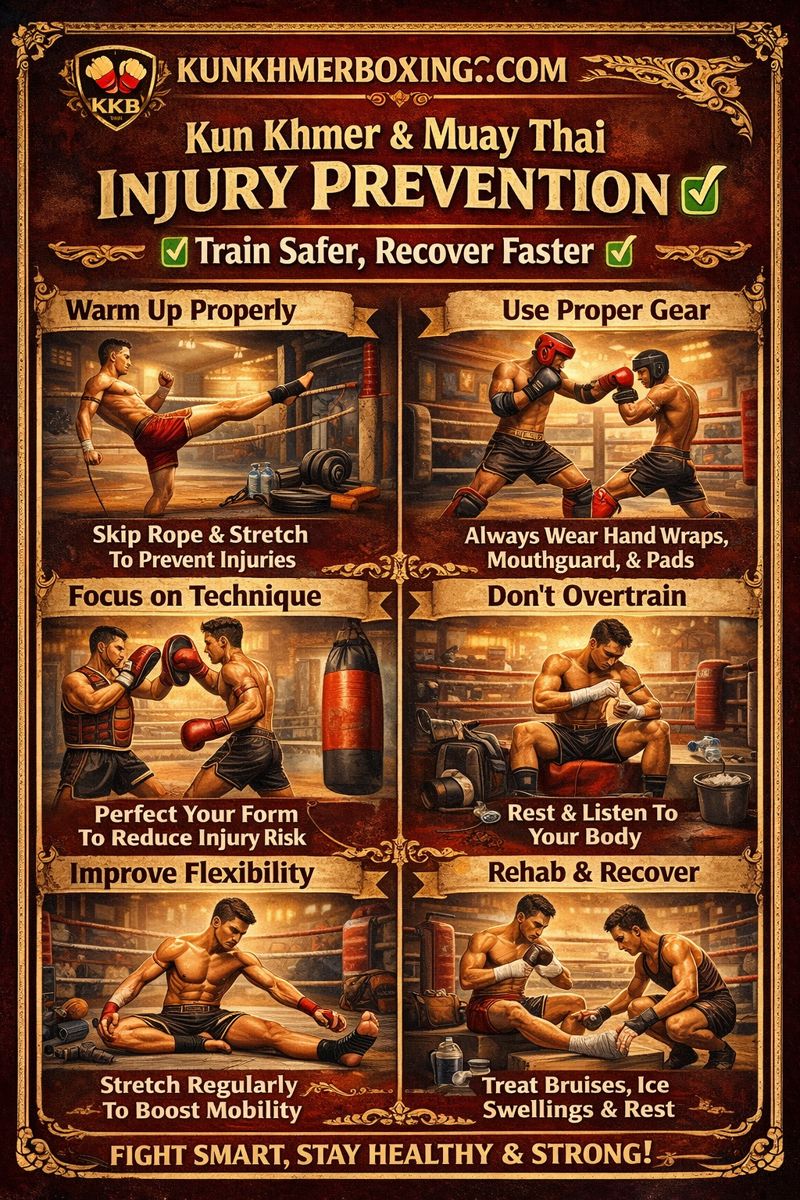
Kun Khmer & Muay Thai Injury Prevention 🛡️🥊 (Train Safer, Recover Faster) Kun Khmer & Muay Thai Injury Prevention 🛡️🥊 (Train Safer, Recover Faster)
Kun Khmer & Muay Thai Injury Prevention 🛡️🥊 (Train Safer, Recover Faster) គឺជាកំណត់ត្រា គុនខ្មែរ ក្នុងមូលដ្ឋានទិន្នន័យ KKB។
English
Let’s be real, Robert: injury prevention is performance. If you can’t train consistently, you can’t improve. This page is your KKB-style guide to train hard, stay sharp, and reduce the most common injuries in Kun Khmer and Muay Thai — without training like a scared person. 😄
Goal: more quality sessions per month, less pain, fewer forced breaks, better technique, and safer sparring. ✅

1. Injury Risk Map (Where Fighters Get Hurt Most) 🗺️
Most injuries in striking come from repetition + bad mechanics + ego sparring. Here’s the KKB breakdown so you can fix the real causes (not just “ice it”). ❄️
| Area | Common Injury | Typical Cause | Best Prevention |
|---|---|---|---|
| Shin / Ankle | Bruise, sprain, tendon irritation | Checking late, poor foot angle, kicking too hard too soon | Check timing + ankle strength + controlled impact ✅ |
| Knee | Ligament strain, patellar pain | Twisting on kicks, bad pivot, landing stiff | Pivot rule + single-leg strength + mobility 🦵 |
| Hip / Groin | Strain, tight hip flexors | Overstretching cold, snapping kicks without control | Warm-up + progressive range + glute activation 🔥 |
| Wrist / Hand | Sprain, knuckle pain | Bad wraps, punching with bent wrist, hard bag ego | Wraps + straight wrist + smart bag rounds ✊ |
| Shoulder | Impingement, tendon pain | Over-punching, weak scap control | Scap work + clean mechanics + volume control 🧠 |
| Neck | Strain, headache, stiffness | Clinch pulling, weak posture, no neck training | Neck isometrics + posture + clinch technique 🛡️ |
2. Warm-Up + Prehab (10–15 Min) 🔥
Warm-up isn’t “stretch and pray.” It’s temperature + joints + nervous system. If you skip it, you pay later.
Best intralink: use this warm-up page before every session 👉 Warm-Up & Stretching (KKB)
2.1 10–15 Min KKB Warm-Up Table 🧩
| Block | Time | What to do | Why it prevents injury |
|---|---|---|---|
| Heat Up | 3–5 min | Light shadow boxing, jump rope, brisk footwork | Warms tissue + improves reaction timing 🔥 |
| Joints | 2–3 min | Ankles, knees, hips, shoulders circles | Lubricates joints + reduces stiffness 🛡️ |
| Activation | 3–4 min | Glute bridges, calf raises, scap push-ups | Turns on stabilizers (ankle/knee/shoulder) ✅ |
| Skill Warm | 3–5 min | Easy teeps, light checks, light jab-cross, guard reset | Preps technique so you don’t “snap cold” ⚡ |
3. Technique Safety Rules (Biggest Injury Saver) 🧠
If you want fewer injuries, fix these 6 rules. They save more bodies than ice, massage, and magic oils combined. 😄
- Rule #1: Pivot on kicks. No pivot = knee pain later. 🦵
- Rule #2: Return to guard after every strike (balance + neck safety). 🛡️
- Rule #3: Don’t “reach” with the head. Step first, then strike. 👀
- Rule #4: Punch with a straight wrist + tight fist (wrap correctly). ✊
- Rule #5: Check with proper shin angle (not toes pointed down). 🦴
- Rule #6: Train skill under control — ego is the #1 injury. 🚫
Useful drill page: Improve your safety footwork here 👉 Step In / Step Out Footwork (KKB)
4. Sparring Safety System (KKB Rules) 🛡️
Sparring should build skill, not create injuries. The best gyms run sparring like a system: control, goals, rounds, rules.
Recommended intralink: 👉 Sparring Guide
4.1 KKB Sparring Levels Table 🎚️
| Level | Intensity | Allowed | Main Goal | Best For |
|---|---|---|---|---|
| Level 1 | Light | Jabs, teeps, touch kicks | Distance + timing | Beginners, recovery days ✅ |
| Level 2 | Medium | Combos, counters, controlled clinch | Decision-making | Most weekly sparring 🧠 |
| Level 3 | Hard (rare) | Fight-style rounds | Camp simulation | Short phases only 🚨 |
Pro tip: If your sparring is always Level 3, you’re training like a highlight reel… and living like an injured fighter.
5. Shin, Knee, Ankle Protection for Kickers 🦵
Kicks win fights — but the legs take damage. The solution isn’t “kick less.” It’s kick smarter.
Drills intralinks (KKB):
5.1 Kick Injury Prevention Table 🧪
| Prehab Drill | Time / Reps | Main Focus | Coaching Tip |
|---|---|---|---|
| Calf Raises (slow) | 3 x 12 | Ankle stiffness + power | Full range, pause at top ✅ |
| Tibialis Raises | 3 x 15 | Shin protection | Control the lowering 🔥 |
| Single-Leg Balance + Eyes Forward | 3 x 30s each | Knee stability | Hips level, no collapse 🛡️ |
| Check Practice (light) | 3 x 10 each | Timing + shin angle | Lift knee first, don’t “kick up” 👀 |
6. Hands, Wrists, Elbows (Punching + Clinch) ✊
Hand injuries usually come from: bad wraps + bent wrist + smashing the bag like you hate it. 😅
6.1 Hand & Wrist Safety Table 🧤
| Problem | Fix | Quick Cue | When to Apply |
|---|---|---|---|
| Bent wrist on impact | Align knuckles + forearm | “Straight wrist, straight line” | Bag + pads + sparring ✅ |
| Knuckle pain | Better wraps + lighter bag rounds | “Skill > power” | After long sessions 🧠 |
| Elbow soreness | Don’t overextend punches | “Punch to target, not through wall” | Pad work + shadow boxing ⚡ |
Helpful intralink: defensive control reduces impacts 👉 Punch Defense (Block, Slip, Counter)
7. Neck, Back, Hips (Clinching + Kicking) 🧍♂️
Stiff neck, tight back, angry hips… that’s usually posture + fatigue + clinch pulling. Fix it with short, regular work.
7.1 Neck & Posture Micro-Routine (6 Minutes) 🧠
| Drill | Time | Focus | Tip |
|---|---|---|---|
| Chin Tucks | 2 x 10 | Neck alignment | Small motion, feel deep neck ✅ |
| Neck Isometrics (front/side/back) | 3 x 10s each | Clinch durability | Push gently, no pain 🛡️ |
| Hip Flexor Stretch (after training) | 2 x 30s | Kick recovery | Ribs down, squeeze glute 🔥 |
8. Recovery Basics: Sleep, Fuel, Deload 😴
Recovery isn’t lazy. It’s how you come back stronger. If you train hard but recover badly, you’ll feel “old” fast. 😄
Recommended intralink: 👉 Nutrition & Recovery
- Sleep: consistent hours beats supplements. 😴
- Hydration: cramps + headaches = performance drop.
- Deload: every 4–6 weeks reduce intensity/volume 20–40%.
- Pain rule: sharp pain = stop. Soreness = manage. 🚨
9. Weekly Injury Prevention Plan (KKB Template) 📅
This is a simple weekly structure you can follow alongside your training. Small work done consistently wins.
Weekly plan hub: 👉 KKB Weekly Training Schedule
| Day | Prehab Focus | Time | What to do |
|---|---|---|---|
| Mon | Ankles + knees | 10 min | Calf + tib raises, balance, light checks 🦵 |
| Wed | Hips + glutes | 10 min | Glute bridges, hip mobility, light kicks 🔥 |
| Fri | Shoulders + wrists | 8 min | Scap work, wraps check, easy shadow boxing ✊ |
| Sat | Neck + posture | 6 min | Chin tucks, neck isos, breathing reset 🛡️ |
10. Equipment Checklist (Cheap Protection, Big Value) 🎒
Equipment hub: 👉 Training Equipment
| Item | Why it matters | Best use |
|---|---|---|
| Hand wraps | Protect wrist + knuckles | Bag, pads, sparring ✅ |
| Mouthguard | Jaw + teeth protection | Sparring only (always) 🛡️ |
| Shin guards | Reduce impact injuries | Technical sparring 🔥 |
| Headgear (optional) | Helps reduce cuts | Controlled rounds 👀 |
11. Red Flags: When to Stop & Get Checked 🚨
- Sharp pain that changes your movement (limp, guarding, stiff neck) ❌
- Swelling that increases after training
- Numbness, tingling, loss of grip strength
- Head impact symptoms: dizziness, nausea, headache, confusion
- Pain that lasts > 7–10 days without improvement
Important: training through these doesn’t make you tougher — it makes you unavailable. ✅
12. FAQ ❓
1) What is the #1 injury prevention habit for Kun Khmer & Muay Thai?
Warm up properly + keep sparring controlled. Most injuries happen when you go hard while cold, or when sparring becomes a fight.
2) Should I stretch before training?
Do dynamic mobility before and long static stretches after. If you stretch hard while cold, your body can tighten up or strain.
3) My shins hurt… do I stop kicking?
Don’t stop completely. Reduce impact, improve checking/kick angles, and add shin/ankle strengthening. Use shin guards for technical days.
4) How many hard bag rounds per week is “safe”?
Depends on your body, but most fighters do best with quality, not volume. If wrists/knuckles are sore, switch to pads or shadow boxing and fix mechanics.
5) What is the fastest recovery strategy after a tough session?
Cool down, rehydrate, eat a real meal, and sleep. Add light mobility later. Recovery basics beat fancy tricks every time. 😴
6) Where should I start if I’m a beginner?
Start here 👉 Beginners Guide and always use the warm-up routine 👉 Warm-Up & Stretching.
Next training step: If you want to build skills safely, combine this page with controlled sessions and smart structure 👉 Training Tips ✅
Support KKB & Cambodian kids: 👉 Donate / Help Children ❤️
ភាសាខ្មែរ
Kun Khmer & Muay Thai Injury Prevention 🛡️🥊 (Train Safer, Recover Faster) គឺជាកំណត់ត្រា គុនខ្មែរ ក្នុងមូលដ្ឋានទិន្នន័យ KKB។
Database context / បរិបទទិន្នន័យ
Kun Khmer & Muay Thai Injury Prevention 🛡️🥊 (Train Safer, Recover Faster) is maintained as a Page record in the KKB master database.
ទិន្នន័យនេះត្រូវបានរក្សាទុក និងធ្វើបច្ចុប្បន្នភាពក្នុងមូលដ្ឋានទិន្នន័យមេ KKB។