
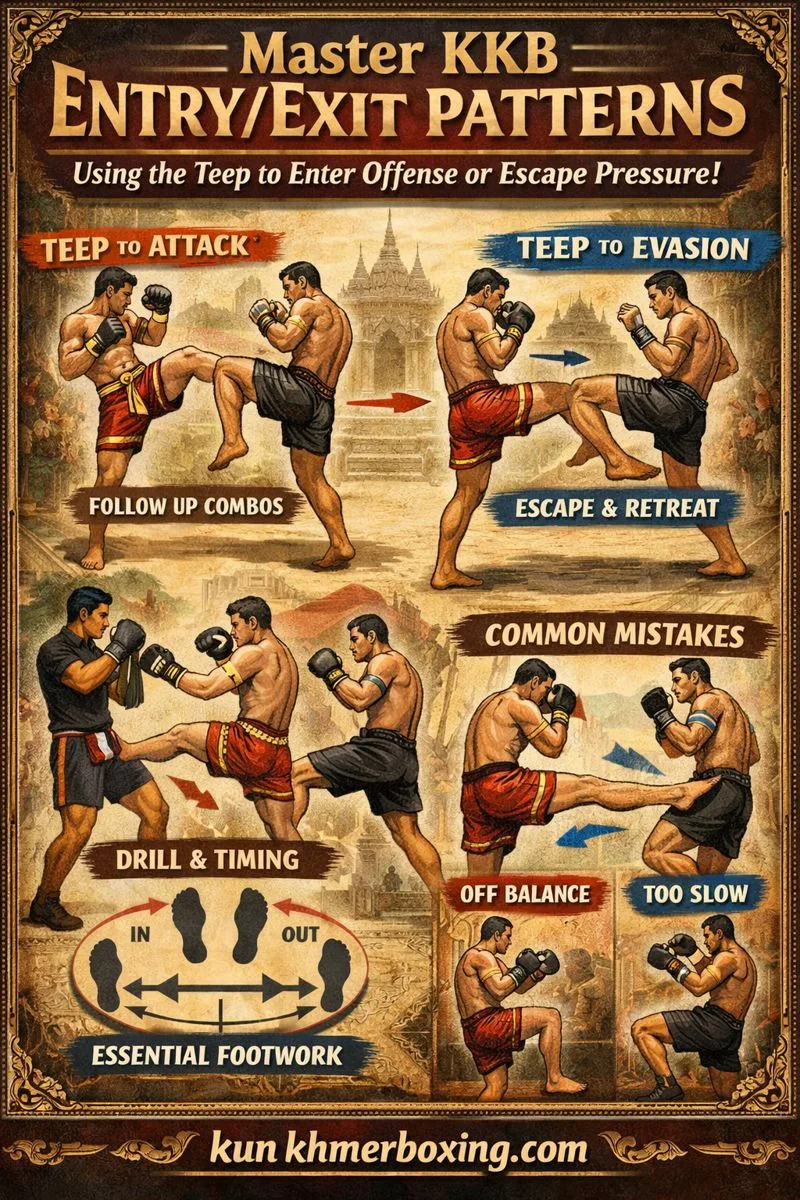
The teep (push kick) is more than a strike — it’s a movement tool. In KKB (Kun Khmer Boxing), the teep is a “door key” 🚪: it opens the way to attack, and it creates space to escape pressure ↩️.
This page breaks down KKB entry/exit patterns that are simple, effective, and easy to drill. You’ll get timing rules, footwork cues, combo examples, training rounds, and the biggest mistakes fighters make.

📌 Table of Contents
- 1. What Are Entry/Exit Patterns (KKB)?
- 2. Why the Teep Is the Best “Door” Technique
- 3. Teep to Enter Offense (Step-In Patterns)
- 4. Teep to Escape Pressure (Exit Patterns)
- 5. Timing & Distance Rules (Don’t Get Countered)
- 6. KKB Combos: Teep → Attack / Attack → Teep Exit
- 7. Drills & Rounds (Beginner → Advanced)
- 8. Common Mistakes (And Fixes)
- 9. Keep Building Your KKB System
- 10. FAQ
1. What Are Entry/Exit Patterns (KKB)?
Entry patterns are the steps you use to safely get into your attacking range. Exit patterns are how you leave the danger zone without getting chased or countered.
In real fights, people don’t get hit because they can’t punch — they get hit because they enter badly or exit slowly. KKB fixes that with clear patterns ✅.
- 🚪 Entry: create a safe opening → step in → attack
- ↩️ Exit: score or defend → create space → reset angle
2. Why the Teep Is the Best “Door” Technique 🚪
The teep is perfect for entry/exit because it controls the fight without needing power.
- 🧭 Controls distance (long weapon)
- 🛑 Stops forward pressure
- 🎯 Breaks rhythm and timing
- 🦶 Sets up step-in punches, kicks, elbows, and clinch
- 🔁 Lets you reset safely after a combo
Opinion: if you master teep entry/exit patterns, you fight calmer, smarter, and you take less damage. That’s real KKB.
3. Teep to Enter Offense (Step-In Patterns) 🔥
“Teep to enter” means you don’t teep just to push — you teep to force a reaction, then you step in behind it.
Entry Pattern 1: Teep → Step In Jab
- Teep (light, fast)
- Foot lands forward (small step)
- Jab immediately (touch + vision)
- Optional: jab-cross then angle out
Entry Pattern 2: Teep → Cross (Straight Line)
- Teep to freeze them
- Step in with cross as they reset
- Finish with low kick or body kick
Entry Pattern 3: Teep → Angle Step → Hook
- Teep (centerline)
- Small step outside their lead foot
- Lead hook / lead elbow option
Entry Pattern 4: Teep → Clinch Entry (Safe Grab)
- Teep to make them upright
- Step in with hands high
- Touch head/neck position → knee
Key thought: Your entry is not “run in.” It’s teep → read → step.
4. Teep to Escape Pressure (Exit Patterns) ↩️
When someone pressures you, the teep is your emergency brake 🛑. But you must use it with correct footwork, or you’ll get walked down.
Exit Pattern 1: Back Teep → Angle Reset
- Back step (small)
- Teep to stop them
- Angle step (left or right)
- Reset stance + guard
Exit Pattern 2: Teep → Pivot Out
- Teep as they enter
- Land and pivot (don’t retreat straight)
- Return with jab or kick if they chase
Exit Pattern 3: Combo → Teep Exit
- Attack (2–4 strikes)
- Teep immediately as your “exit lock”
- Step away or angle out
Exit Pattern 4: Teep to the Hip Line (Stop the March)
- Teep lower (belt/hip line)
- Goal: break forward drive
- Reset + jab
5. Timing & Distance Rules (Don’t Get Countered) ⏱️
The teep works when you respect timing. Use these rules:
- ✅ Teep early: when they are stepping in (not already in your face)
- ✅ Recover fast: foot back to stance, hands high
- ✅ Don’t show it: no big knee lift for 2 seconds
- ✅ Mix targets: body teep + hip-line teep
- ✅ Exit after teep: angle step beats backpedal
Common counter you must respect: catch + sweep, or step-in punch as your leg returns. That’s why recovery is everything.
6. KKB Combos: Teep → Attack / Attack → Teep Exit 🥊
A) Teep to Enter Offense (5 easy combos)
- 1) Teep → Jab → Cross → Angle out
- 2) Teep → Cross → Low kick → Guard
- 3) Teep → Jab → Lead hook → Rear kick
- 4) Teep → Step in → Lead elbow → Exit
- 5) Teep → Clinch touch → Knee → Teep exit
B) Teep to Escape Pressure (5 safe combos)
- 6) Block → Teep → Angle step → Jab
- 7) Teep → Pivot → Cross (if they chase)
- 8) Jab → Cross → Teep exit → Reset
- 9) Low kick → Teep exit → Step out
- 10) Teep (hip line) → Jab only → Move
7. Drills & Rounds (Beginner → Advanced) 🧠
Training Drill Table (Use this weekly) ✅
| Drill | Goal | Rounds | Link |
|---|---|---|---|
| Teep basics (lift → extend → recover) | Fast recovery + balance | 3 × 2 min | KKB Teep Technique Basics |
| Step in / Step out footwork | Safe entries and exits | 3 × 2 min | Step In Step Out Footwork |
| Angle exit drill | Escape pressure | 3 × 2 min | Angle Exit Drill |
| Jab-cross then exit | Hit and don’t get hit | 3 × 2 min | Jab Cross Exit Drill |
| Teep wall drill | Accuracy + structure | 3 × 2 min | KKB Teep Wall Drill |
Simple Round Plan (15 minutes) 🔥
- Round 1: teep only + recovery (light)
- Round 2: teep → jab-cross (clean)
- Round 3: teep → angle step → hook/elbow
- Round 4: pressure defense: block → teep → angle
- Round 5: free round (only 2 patterns, perfect them)
8. Common Mistakes (And Fixes) ⚠️
- ❌ Big slow teep → ✅ shorter lift, faster snap
- ❌ Hands drop when teeping → ✅ guard stays high
- ❌ Teep and admire → ✅ teep then step/angle
- ❌ Exit straight back always → ✅ angle exit + pivot
- ❌ Same teep target → ✅ mix body + hip line
My take: most fighters don’t need “more power” — they need cleaner entry/exit habits. Teep patterns fix that fast.
9. Keep Building Your KKB System 🧱
To level up your full Kun Khmer style, connect these pages together:
- 📚 Technique hub: Kun Khmer Techniques
- 🧠 Training tips: Training Tips
- 🦶 Teep + distance day plan: Day 2 – Teep + Range Control
- 🎯 Distance style: Day 1 – Outfighter Distance
- 🥊 Shadow work: Shadow Boxing KKB
- 🛡️ Safety first: Injury Prevention
10. FAQ ❓
When is the best time to teep to escape pressure?
The best time is as they step in. If you wait until they’re already in clinch range, the teep becomes risky. Early timing = safe timing.
How do I use the teep to enter offense?
Teep lightly to force a reaction, then step in immediately behind it with jab, cross, kick, elbow, or clinch entry. Think: teep → read → step.
What if my opponent catches my teep?
Improve recovery speed, hide your teep with feints, and mix targets. If they catch, keep balance, pull the leg back fast, and angle out.
Is footwork more important than power for entry/exit?
Yes. Power helps, but entry/exit success is mostly distance + timing + angles. Clean footwork makes everything safer and sharper.
Is this good for beginners?
100%. Beginners should drill 2 patterns only: teep → jab and block → teep → angle. Simple is best.